Computational Neuroscience

A new dimension to access content of this website
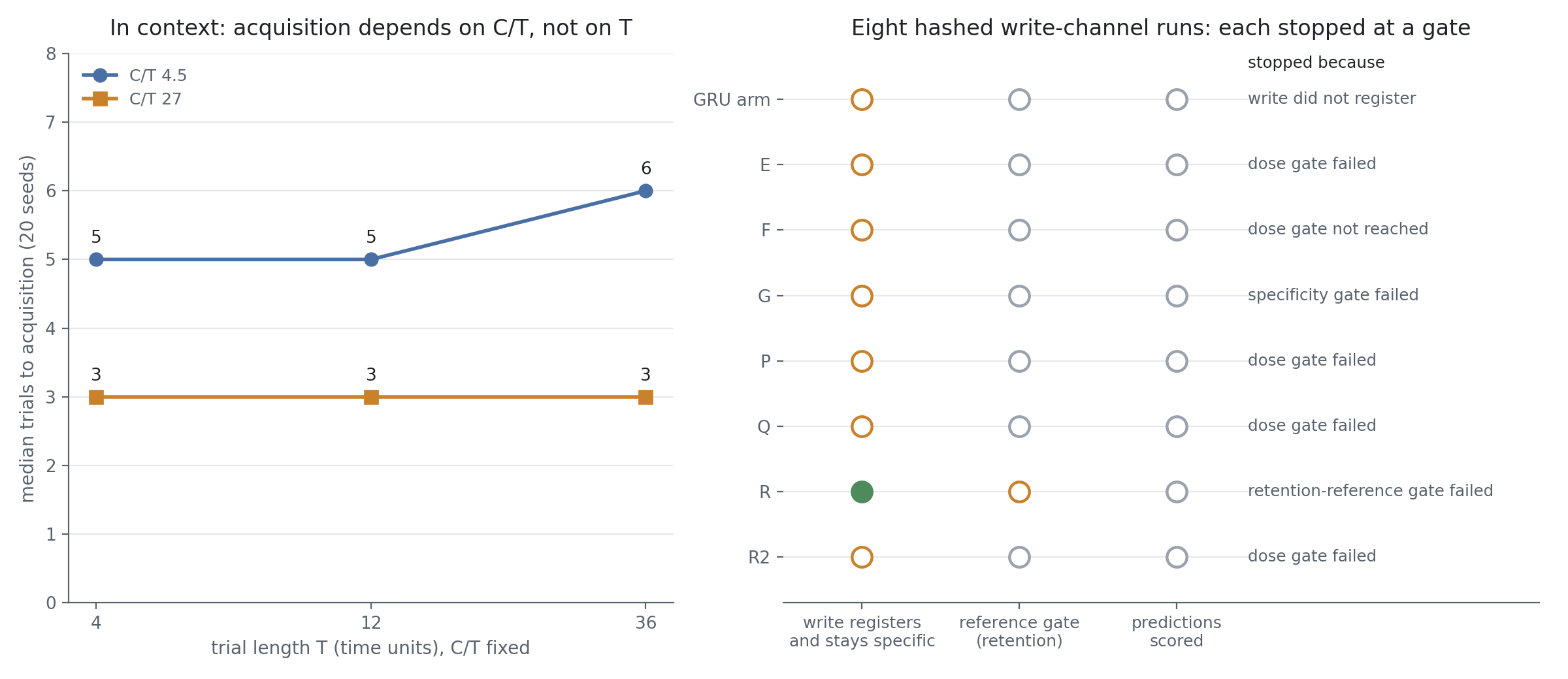
Left: median trials to acquisition for a meta-trained transformer at trial lengths T of 4, 12 and 36: 5, 5 and 6 at C/T 4.5 and 3, 3 and 3 at C/T 27, so acquisition depends on C/T and not on T. Right: eight hashed write-channel runs (GRU arm, E, F, G, P, Q, R, R2) against three stages, write registers and stays specific, retention reference gate, predictions scored; only R passed the first stage and it failed the second, so no run reached scoring.

Where an inference law lives

Artificial and animal learners compared on one conditioning instrument against one ideal observer. A meta-trained transformer acquires a cue-reward contingency in context with timescale invariance; eight pre-registered runs on a surprise-gated write channel all stopped at a gate, and the last gave an exploratory reason why.
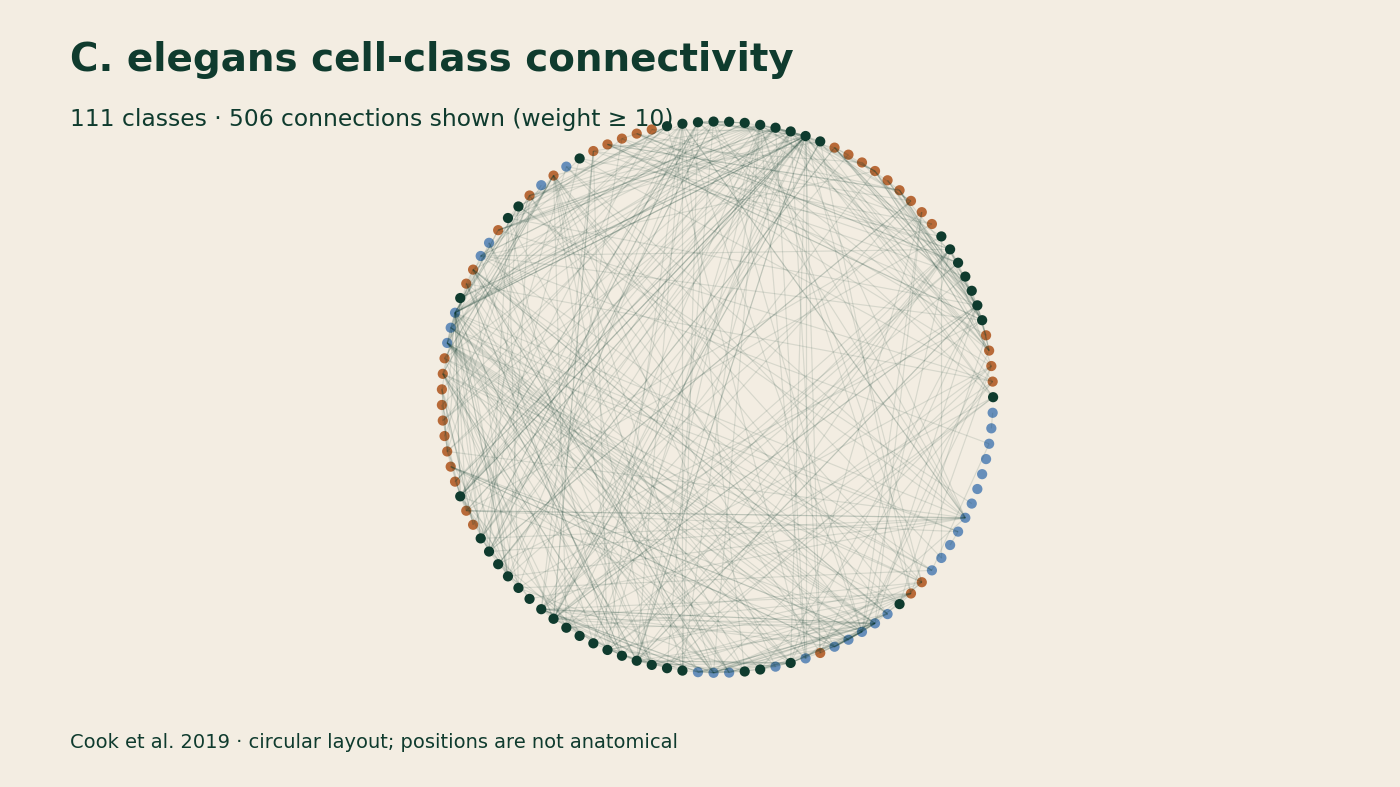
Cook et al. cell-class connectivity, showing connections with weight at least 10 in a non-anatomical circular layout.

C. elegans: connectivity, gene expression, and simulation

A computational neuroscience learning pipeline combining connectomics, gene expression, neural models, and an interactive worm simulator, with documented validation limits.
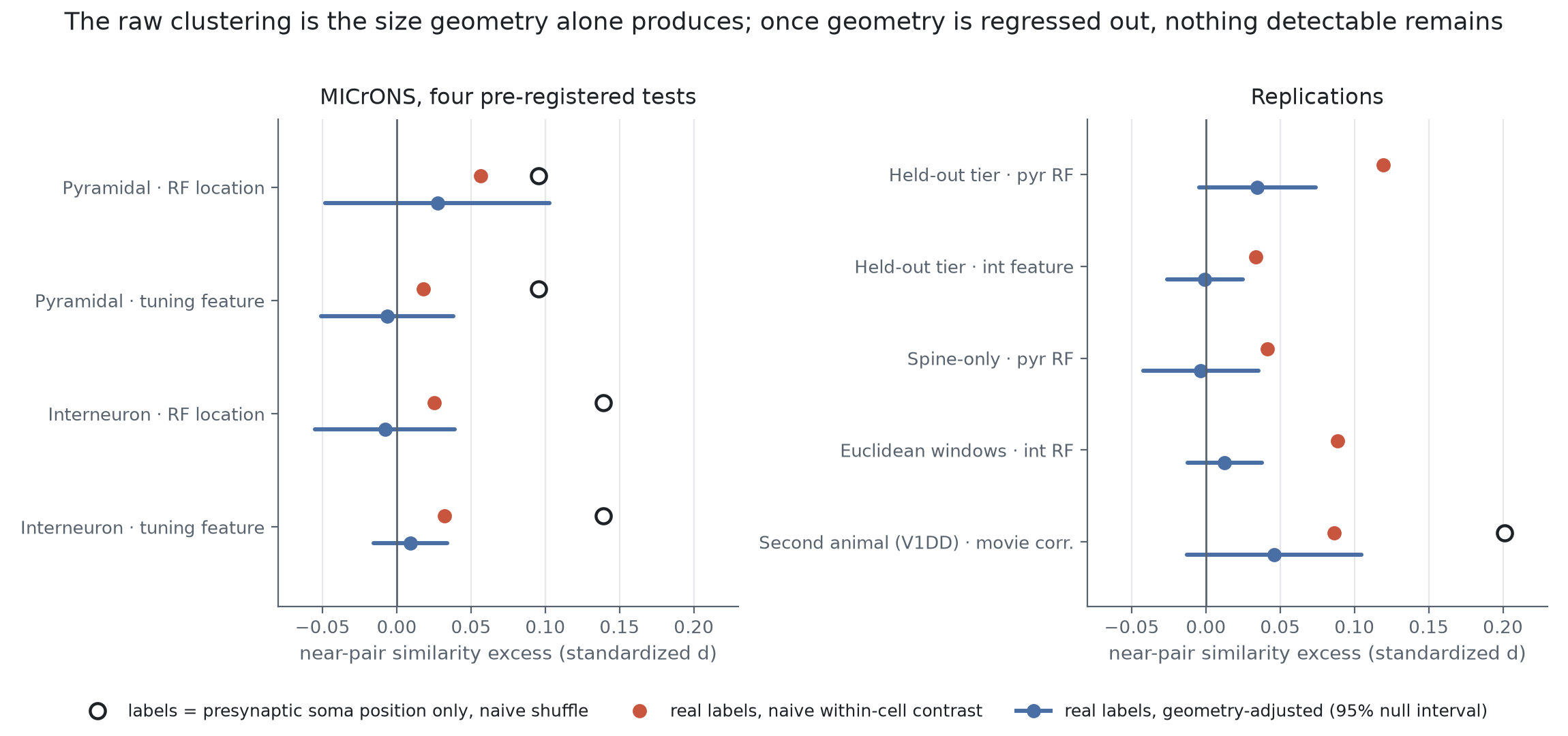
Dot plot of near-pair similarity excess on MICrONS dendrites: labels built only from presynaptic soma position give a larger naive excess than the real functional labels, and the geometry-adjusted estimates sit on zero in the four pre-registered tests and in five replications including a second animal

Dendritic input clustering in MICrONS is presynaptic geometry

Do co-tuned inputs land together on cortical dendrites? In MICrONS the standard shuffle test calls pure soma geometry clustering (p = 0.001); adjusted for it, receptive-field placement is bounded at d ≤ 0.019.
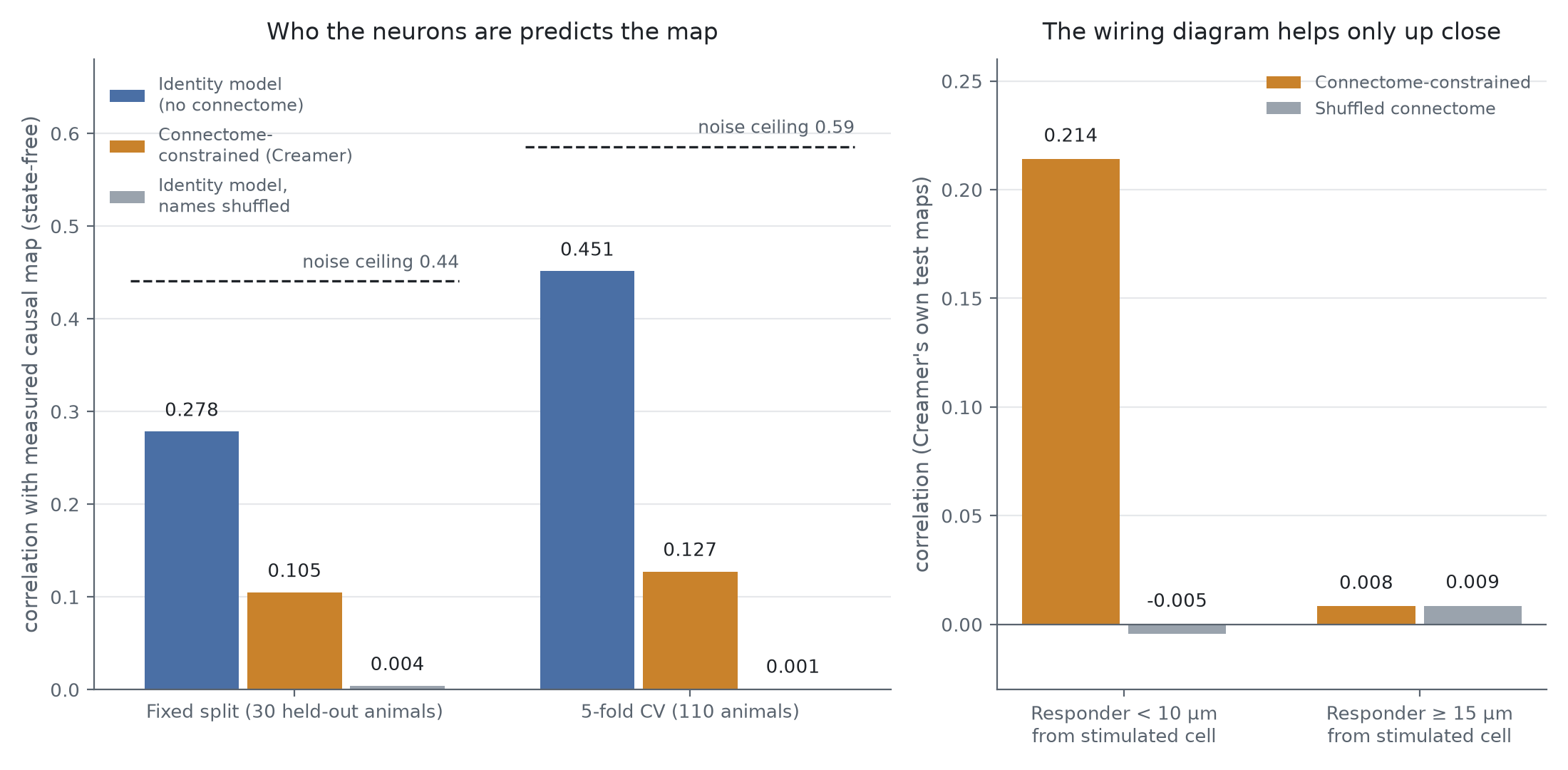
Left: state-free prediction of the measured causal map in held-out worms. An identity-indexed model with no connectome scores 0.278 (fixed split, ceiling 0.44) and 0.451 (cross-validation, ceiling 0.59), against 0.105 and 0.127 for a connectome-constrained model and about zero with shuffled neuron names. Right: on its own test maps the connectome-constrained model beats a shuffled connectome within 10 µm of the stimulated neuron (0.214 vs -0.005) but not beyond 15 µm (0.008 vs 0.009).

Predicting causal signal flow in the C. elegans brain

Predicting how stimulating one C. elegans neuron moves the others in unseen worms: neuron identity reaches 77% of the noise ceiling (r = 0.451); the wiring diagram helps only within ~10 µm.
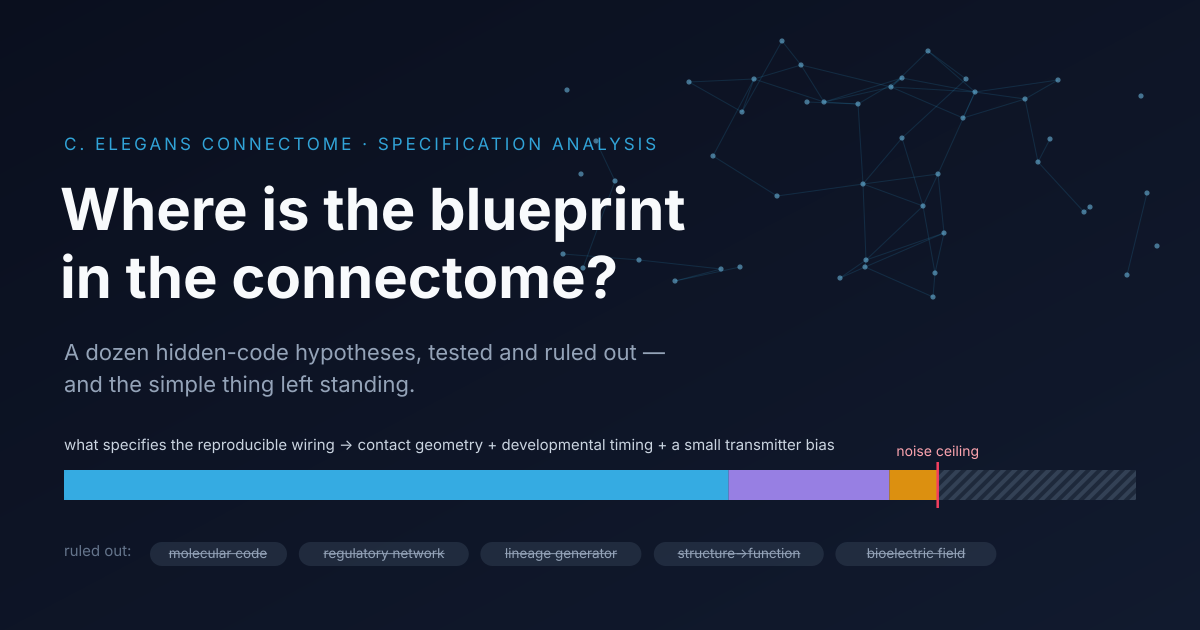
Where is the blueprint in the C. elegans connectome — a decomposition of reproducible wiring into contact geometry, developmental timing, and a small transmitter bias, with the falsified hidden-code hypotheses

How development shapes the C. elegans connectome

Testing how physical contact, developmental timing, and molecular signals account for reproducible wiring in C. elegans, using matched controls and held-out connectomes.
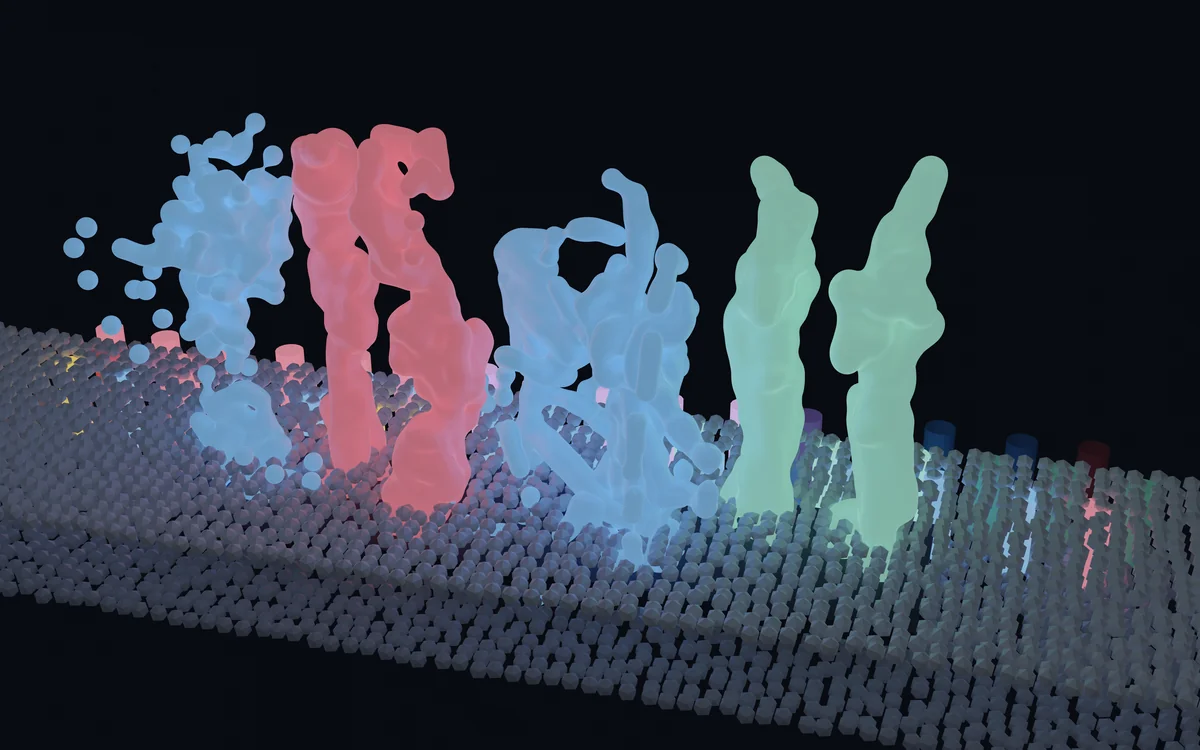
C. elegans Tier4 substrate anatomy — 3D rendering of the whole-cell electrical model

Interactive anatomy of a C. elegans neural model

A 3D explorer of a 300-cell Brian2 model, showing ion channels, receptors, pumps, synapses, and the integration status of each modeled component.
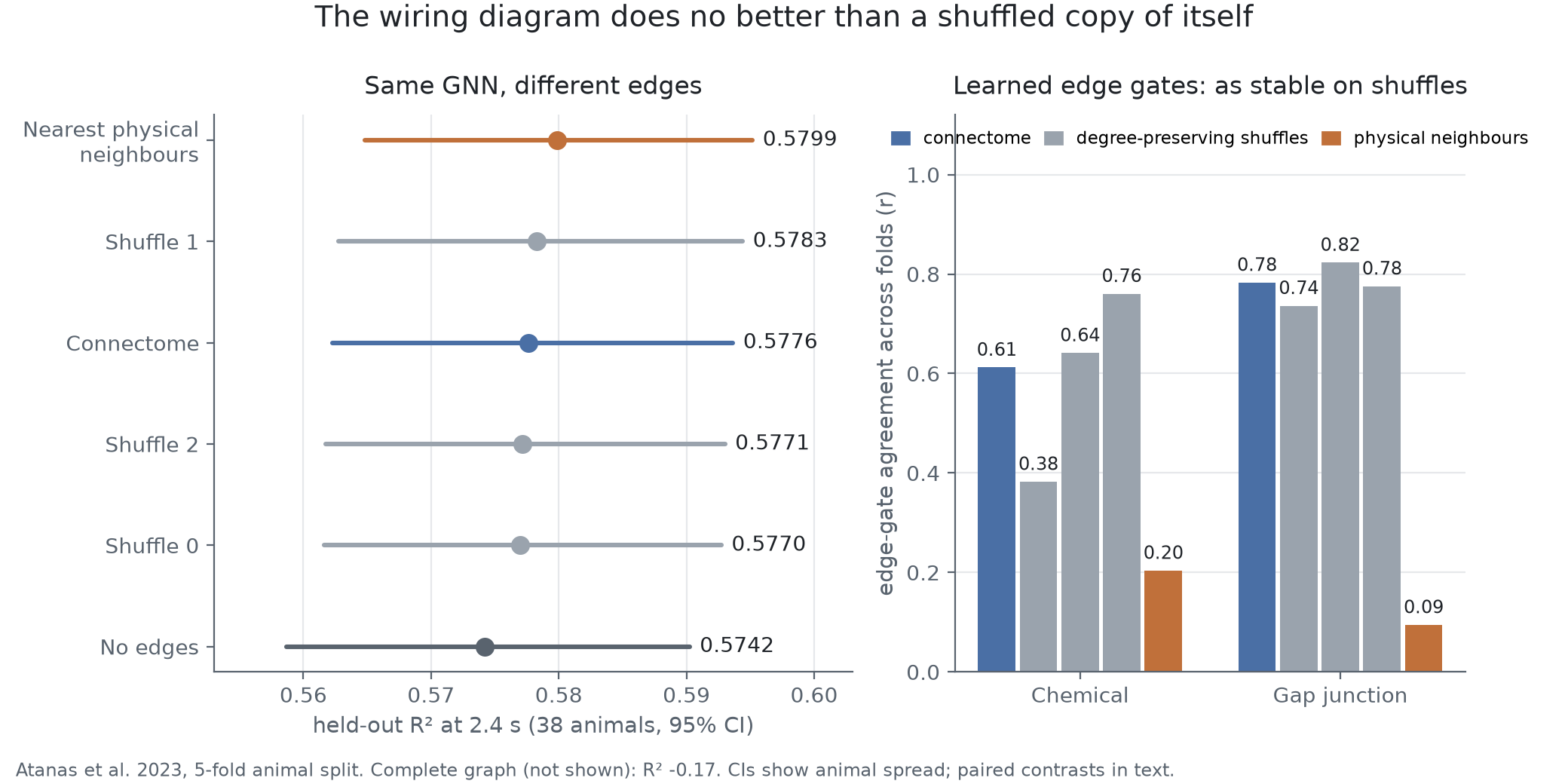
Left: held-out R² of one graph neural network trained with different edge sets; the connectome (0.5776) sits among three degree-preserving shuffles (0.5770–0.5783) and below nearest physical neighbours (0.5799). Right: learned edge gates are as stable across folds on shuffled graphs as on the connectome.

Connectome Graph Dynamics

Frozen held-out benchmarks on public whole-brain C. elegans data: in a learned graph network the real connectome scores the same as degree-preserving shuffles (+0.0001 R² [−0.0007, +0.0009]).
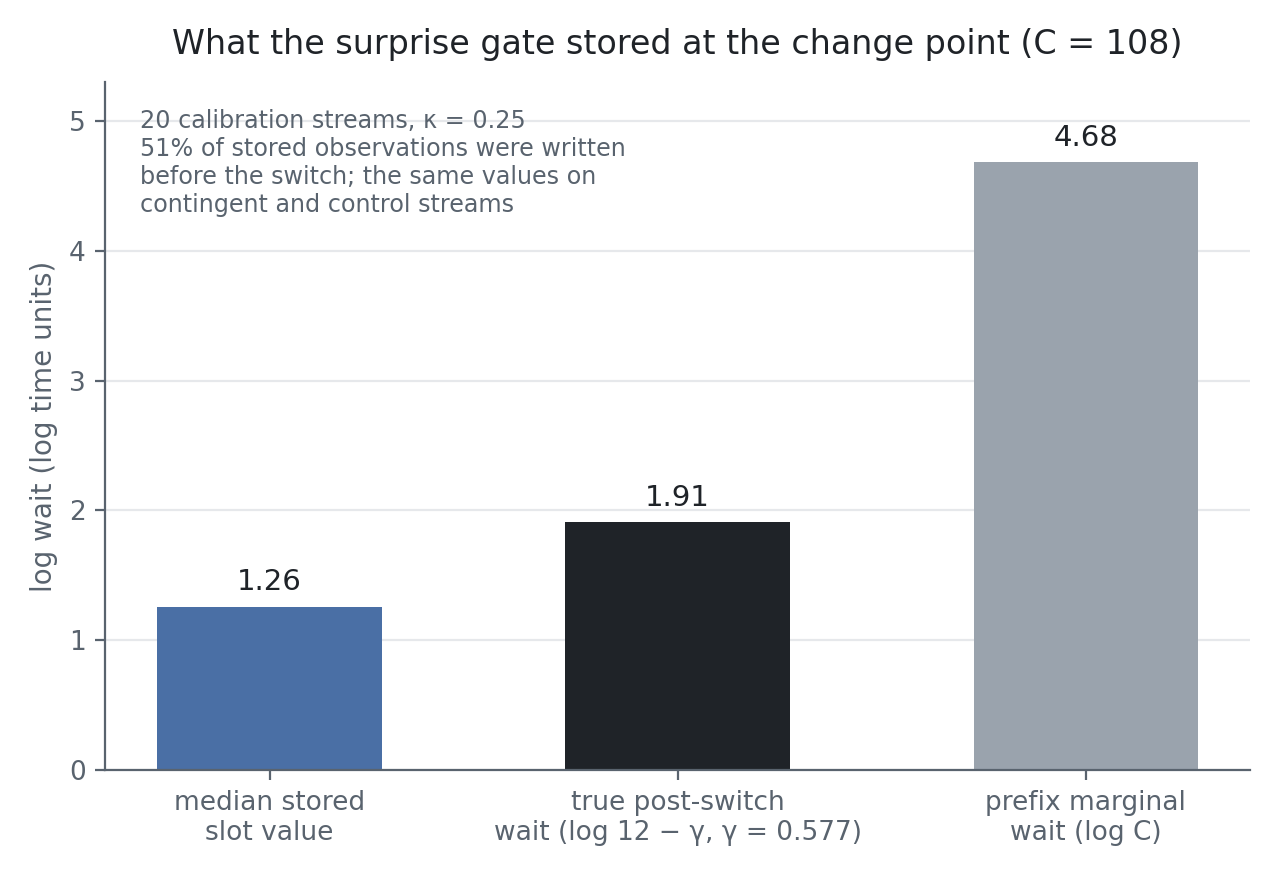
Three bars of log wait in the amendment R2 diagnostic: the median value the surprise-gated store held at the change point, 1.26 log units; the true post-switch wait, 1.91; and the non-contingent prefix marginal, 4.68. A note records that 51% of the stored observations were written before the switch and that the values were the same on contingent and control streams.

Eight hashed runs on the write channel, and what a gate outcome closes

A week of pre-registered tests asking whether a surprise-gated write channel adds anything an in-context prior lacks. Every prediction file was hashed before scoring; every gate stayed where it was; the predictions were never scored, eight times, and the eighth run explained the other seven.
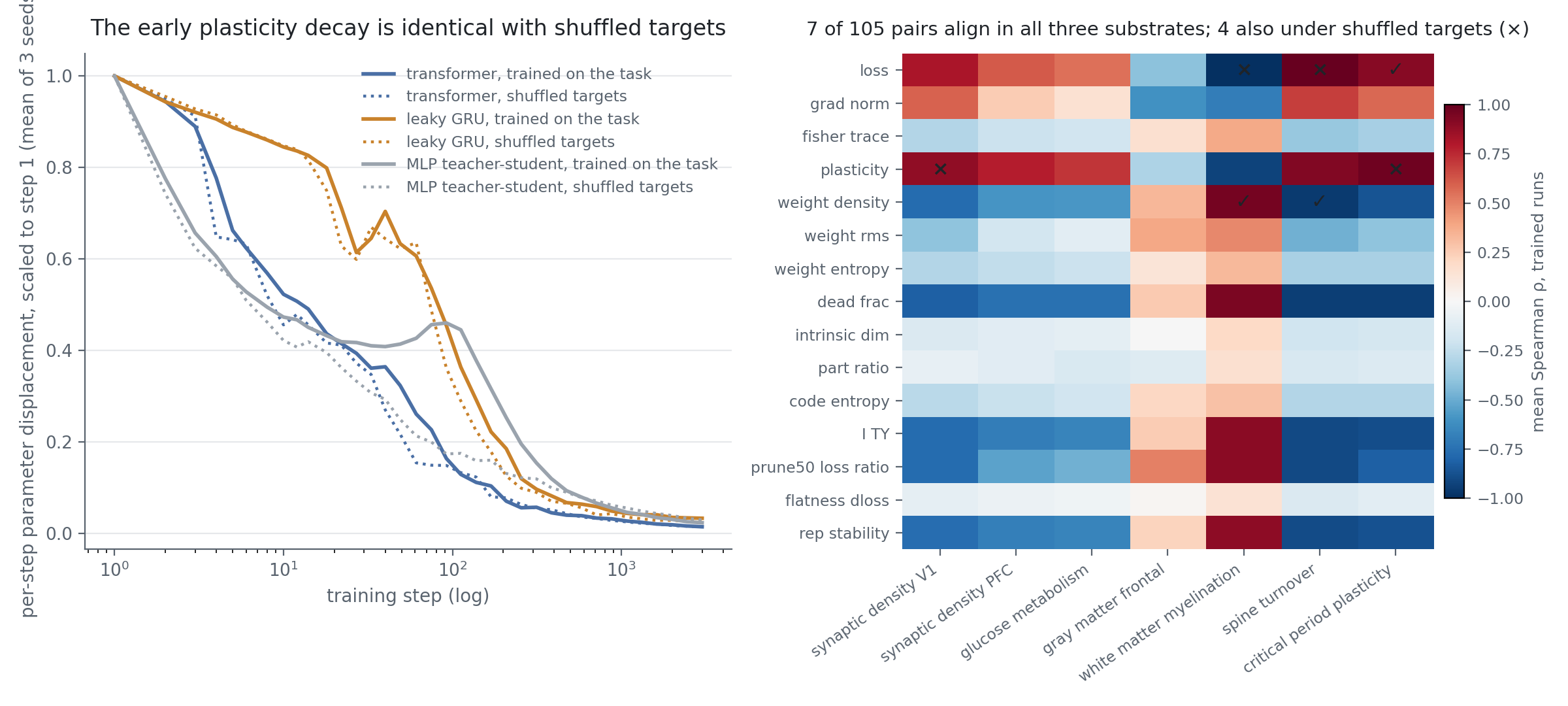
Left: the plasticity metric, per-step parameter displacement, over log training step for a transformer, a leaky GRU and an MLP, each trained on its task (solid) and on shuffled targets (dotted); every curve is largest at step 1 and decays, and the trained and shuffled curves lie on top of each other in all three substrates. Right: a 15 by 7 heat map of mean Spearman correlation between each training metric and each developmental curve; 7 of 105 pairs align in all three substrates, marked with a tick, and 4 of those also align under shuffled targets, marked with a cross.

Every curve looks like development

Fifteen training-trajectory metrics on three small networks against seven reconstructed developmental curves: 7 of 105 pairs align in every substrate, four of them also under shuffled targets, and all seven are a monotone or decaying curve against another. The battery's own shape classifier reported an early inverted U that review traced to a filled-in missing value. A shuffled-target control should be mandatory for any claim of this kind.
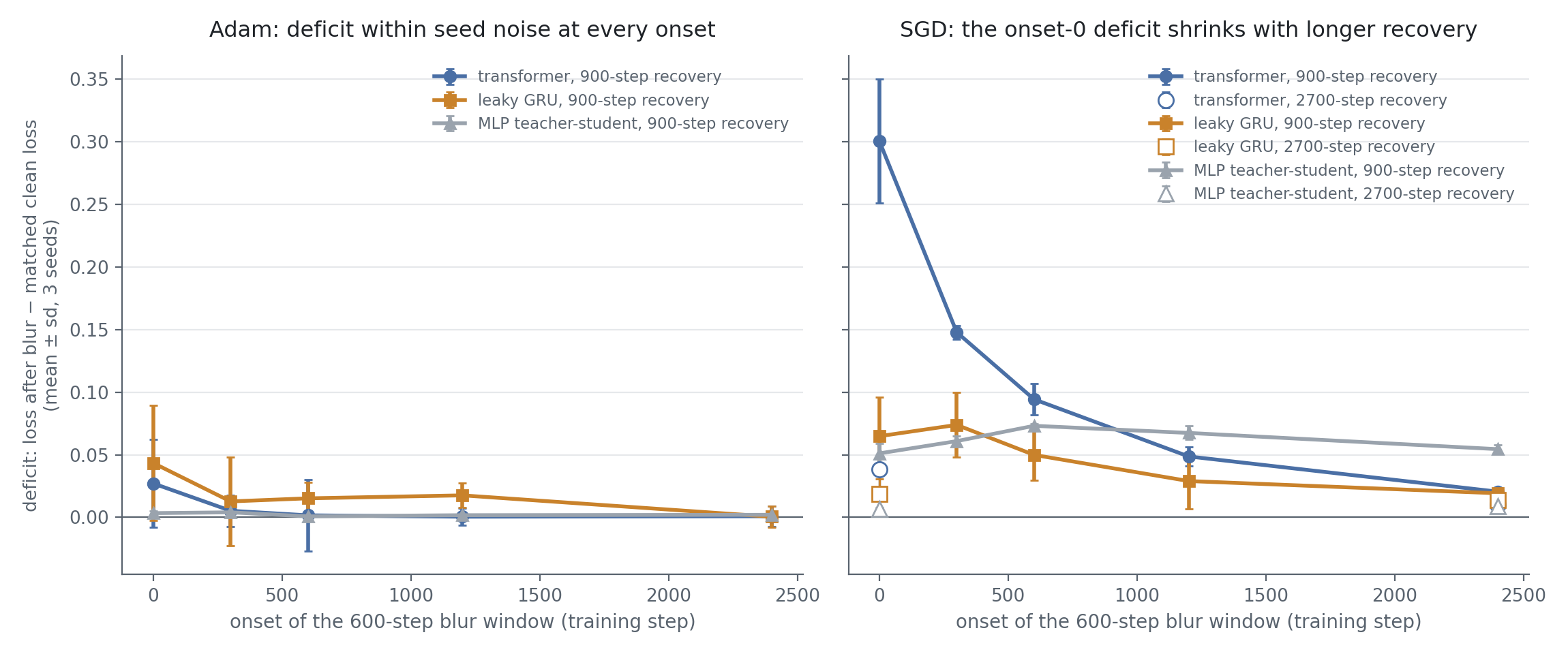
Deficit in held-out loss after a 600-step blur window relative to matched clean training, against blur onset from step 0 to 2400, for a transformer, a leaky GRU and an MLP, three seeds each. Under Adam every point is within about 0.04 of zero with error bars crossing it. Under SGD the transformer reads 0.30 at onset 0, falling to 0.02 at onset 2400, and hollow markers show the same onsets with recovery tripled to 2700 steps: 0.038 and 0.010 for the transformer, 0.019 and 0.014 for the GRU, 0.007 and 0.009 for the MLP.

No critical period in a small network

A 600-step input deficit at five onsets, on three small networks under Adam and SGD. Under Adam the deficit is within seed noise at every onset. Under SGD it is largest at onset 0 and shrinks eightfold when recovery is tripled, from 0.30 to 0.038 on the transformer, still positive in all three seeds and still falling: recovery-limited on the evidence, not shown to be zero. What Achille's convnets add that these runs did not.
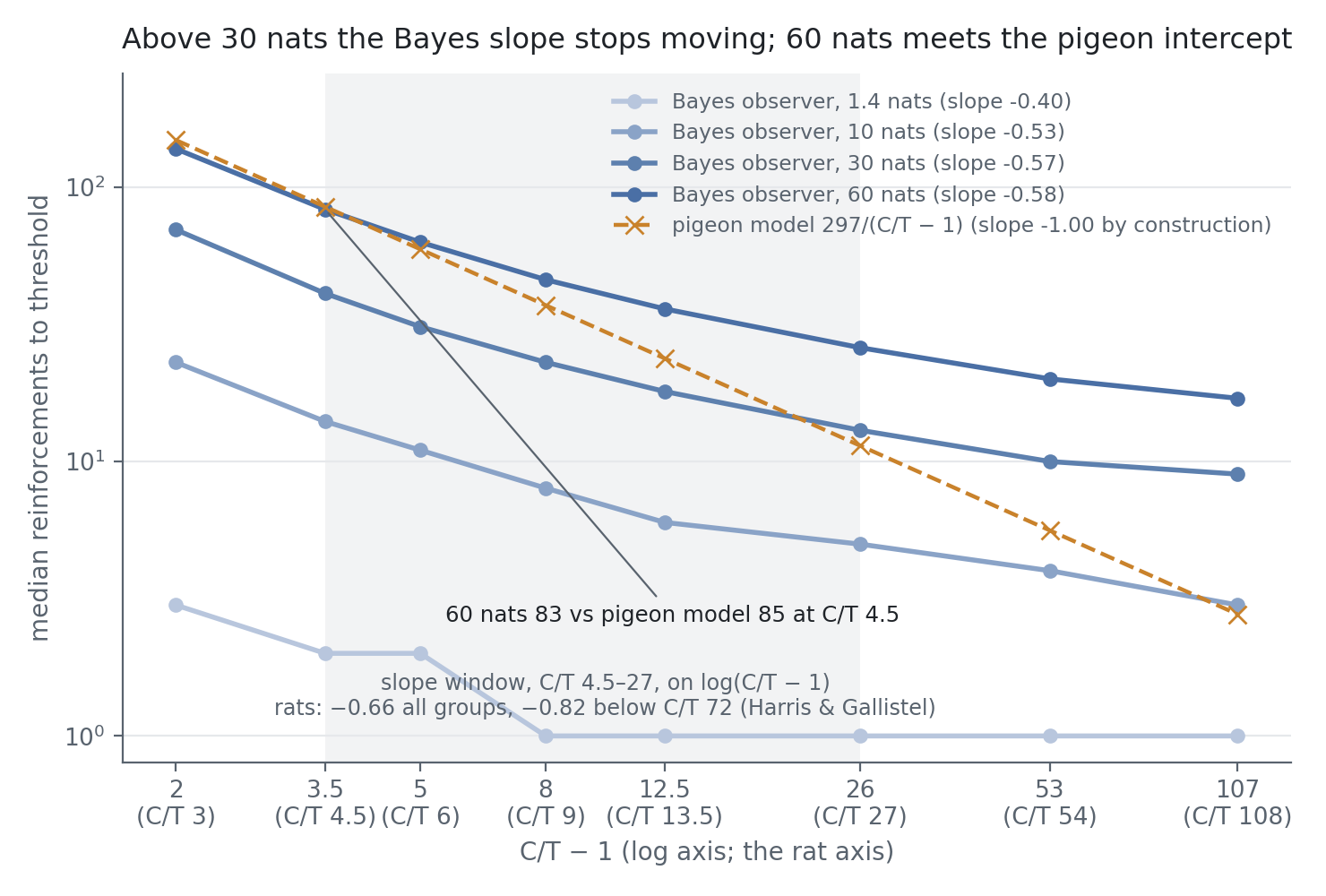
Median reinforcements to a posterior-odds threshold against C/T − 1 from 2 to 107, log-log, for an ideal rate observer at thresholds of 1.4, 10, 30 and 60 nats, with the one-parameter pigeon model 297/(C/T − 1) dashed. Slopes on log(C/T − 1) over C/T 4.5 to 27 are −0.40, −0.53, −0.57 and −0.58 for the observer and −1.00 for the pigeon model; at C/T 4.5 the 60-nat observer reads 83 against the pigeon model's 85. The rat slopes, −0.66 across all groups and −0.82 below C/T 72, are noted.

Sixty nats

An ideal rate observer's trials-to-threshold slope on the animal axis, log(C/T − 1), stops moving above about 30 nats, at −0.57 to −0.58 over C/T 4.5 to 27, against −0.66 for rats across all groups and −1 by construction for the one-parameter pigeon model. At 60 nats it also lands on the pigeon intercept, 83 trials against 85 at C/T 4.5. One fitted parameter, one free prediction.
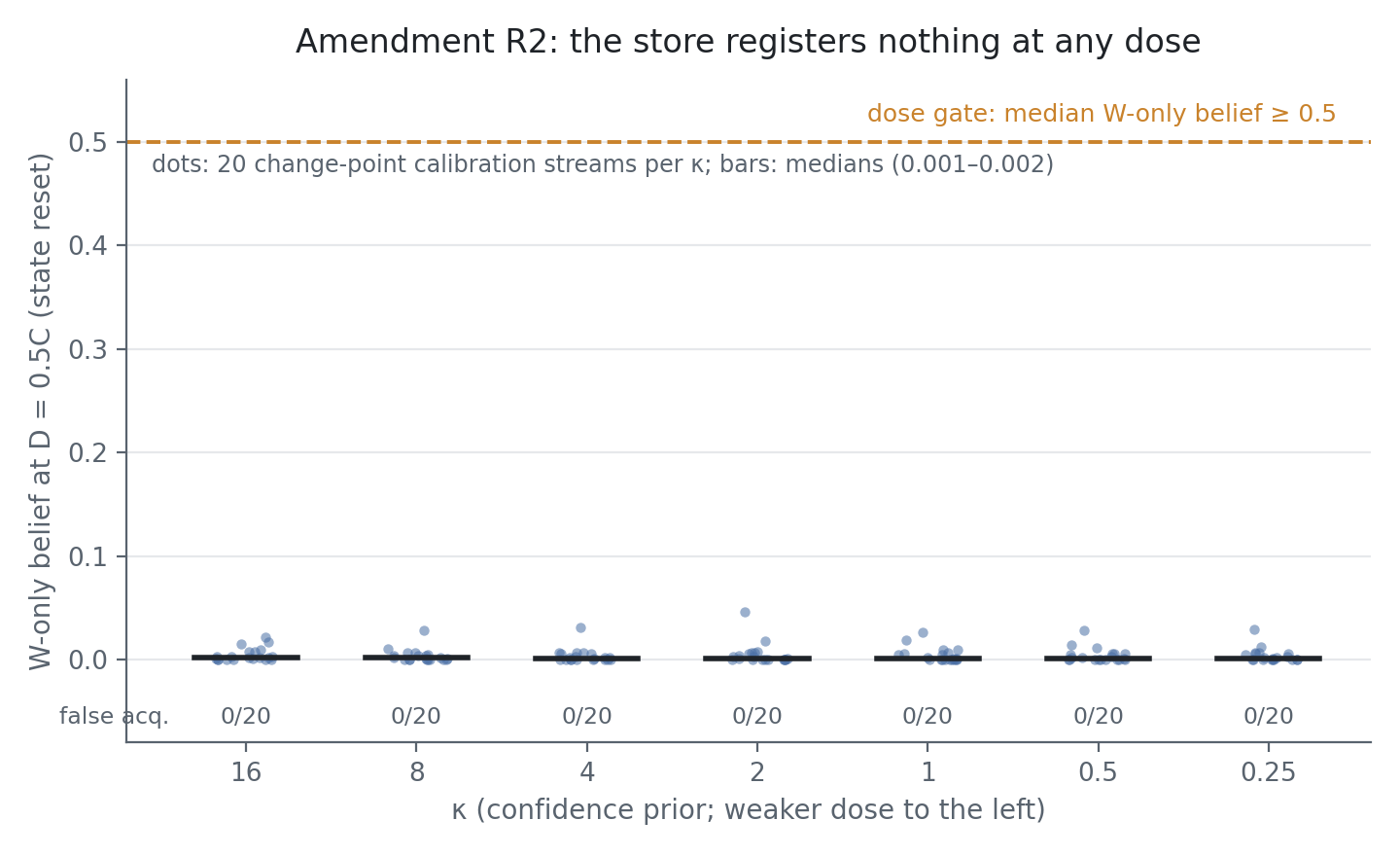
Write-only belief at a 0.5C probe after a state reset, for 20 change-point calibration streams at each confidence pseudo-count kappa from 16 down to 0.25. Every median sits between 0.001 and 0.002 against a dose gate of 0.5, the largest single stream reads 0.046, and false acquisitions on the control streams are 0 of 20 at every kappa.

The surprise gate is a biased sampler

A write channel gated on prediction error never opened where the meta-trained prior was good. Moved to streams where the prior is wrong, it wrote, but only chance-short waits, the same on signal and control: half the store filled before the change point, and the stored value sat at 1.26 log units against a true 1.91. The exploratory diagnostic that closed the error-surprise gate as an operationalisation and named its replacement.
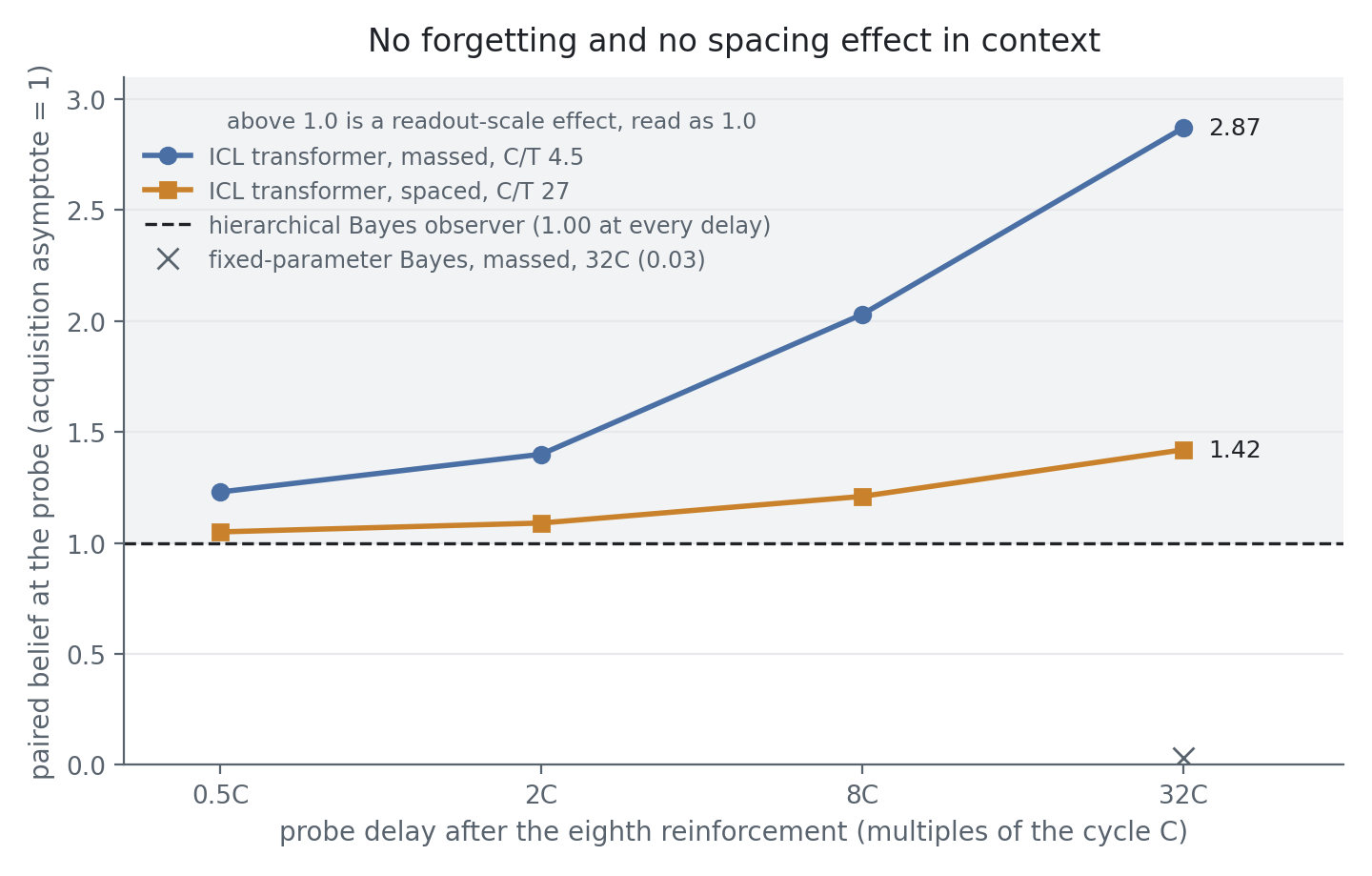
Paired belief at a single probe cue against delay after the eighth reinforcement, 0.5C to 32C, for a meta-trained transformer. Massed training at C/T 4.5 reads 1.23, 1.40, 2.03 and 2.87; spaced training at C/T 27 reads 1.05, 1.09, 1.21 and 1.42; neither falls below the acquisition asymptote of 1. A hierarchical Bayes observer sits at 1.00 at every delay, and a fixed-parameter Bayes observer collapses to 0.03 at 32C on the massed schedule. Values above 1 are marked as a readout-scale effect.

Where learning lives: prior, inference, write

Every learner is three things: a prior it starts with, an inference it makes in state, and a write that makes the inference permanent. The laws animals and in-context learners share live in the second; the differences live in the first and third. A retention probe on a meta-trained transformer gives the inference-only signature, once its reference is read honestly.